Giant tortoises return to the wild in Galapagos under NASA guidance
Istanbul, 21 February (Hibya) - Giant tortoises are returning to the wild on Floreana Island in the Galápagos for the first time in more than 150 years, guided by NASA satellite data that help scientists identify habitats where the animals can find food, water, and nesting sites.
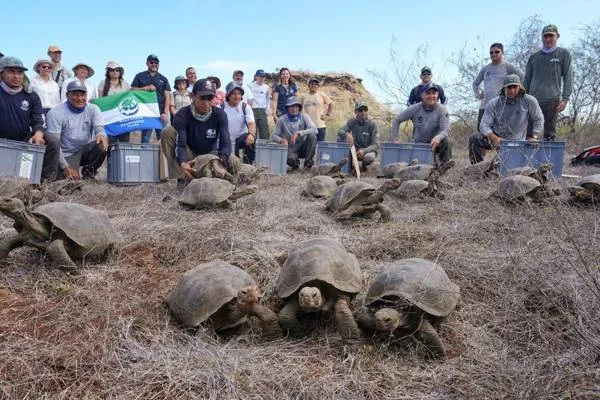
Scientists describe the effort, carried out in collaboration with the Galápagos National Park Directorate and the Galápagos Conservancy, as a “major milestone” in restoring tortoise populations to one of the world’s most ecologically distinct archipelagos.
According to NASA, tortoises disappeared from Floreana Island in the mid-1800s due to intensive hunting by whalers and the introduction of new predators such as pigs and rats that fed on tortoise eggs and hatchlings. Without tortoises, the island began to change. Historically, giant tortoises in the Galápagos helped shape the landscape by grazing vegetation, creating pathways through dense plant growth, and dispersing seeds between islands.
Keith Gaddis, program manager for Biodiversity and Ecological Forecasting at NASA Earth Action at NASA Headquarters in Washington, said in a statement:
“This is the kind of project where NASA’s Earth observations make a difference. We are helping our partners answer a practical question: Where will these animals have the highest chance of survival not just today, but decades from now?”
On February 20, the Galápagos National Park Directorate and conservation partners released 158 giant tortoises in two areas of Floreana. James Gibbs, Vice President of Science and Conservation at the Galápagos Conservancy and co-lead researcher of the project, said: “The return of these tortoises to the island is a very significant event. Charles Darwin was one of the last people to see them there.”
In 2000, scientists made an unexpected discovery. Gibbs and other researchers found unusual tortoises on Wolf Volcano, located in the northern part of Isabela Island, the highest peak in the Galápagos, that did not resemble any known tortoise species.
About a decade later, DNA extracted from the bones of extinct Floreana tortoises found in caves and museum collections confirmed that these tortoises were descended from the Floreana lineage, leading to the launch of a breeding program that has since produced hundreds of offspring expected to return to the island. Researchers believe whalers likely transported tortoises between islands more than a century ago, resulting in this situation.
Over the past 60 years, the Galápagos National Park Directorate has bred and released more than 10,000 tortoises in the Galápagos, making it one of the largest rewilding efforts ever undertaken. However, each island presents a different puzzle.
Some hills and small mountains in the Galápagos trap clouds and remain cool and moist with evergreen vegetation. Others are so dry that green vegetation appears only briefly after rainfall. When these areas coexist on the same island, tortoises move between them, and some animals travel miles each year between seasonal feeding and nesting sites.
Gibbs said, “This is challenging for tortoises because they are brought into this environment from captivity. They don’t know where the food is. They don’t know where the water is. They don’t know where to nest. If you can place them in an area where conditions are already suitable, you give them a much better chance.”
British News Agency
 Facebook
 Tweeter
 Whatsapp